
ROCKin'teriors
Eco-Friendly stone fabrication and installation
Natural beauty for your favorite space
What Are the Top Eco Friendly Building Materials in 2026?
In 2026, a greener building is not defined by one material or a “natural” label. Its impact depends on where materials come from, how they are made, how far they travel, and how long they last. A bamboo floor may grow quickly, yet still carry a heavy footprint if it is shipped far or replaced often. Details matter.
Architect William McDonough, known for advancing circular design, helped popularize the principle “Waste equals food.” It offers a useful lens for evaluating the Most Environmentally Friendly Building Materials: can a material be reused, recycled, or safely returned to the environment? This guide compares reclaimed timber, responsibly sourced bamboo, recycled steel, lower-carbon concrete, cork, cellulose insulation, and hempcrete. It also considers practical trade-offs, from moisture control to maintenance and local availability.
There is no universal winner. That is the uncomfortable part. A material with low manufacturing emissions may perform poorly in a damp climate, while a durable option may require more processing upfront. The right choice depends on the whole building, not a single product label. We will look at embodied carbon, sourcing, durability, indoor comfort, and end-of-life potential, while noting where evidence or local conditions can change the answer. The aim is practical: help readers ask better questions before choosing materials for a real project.
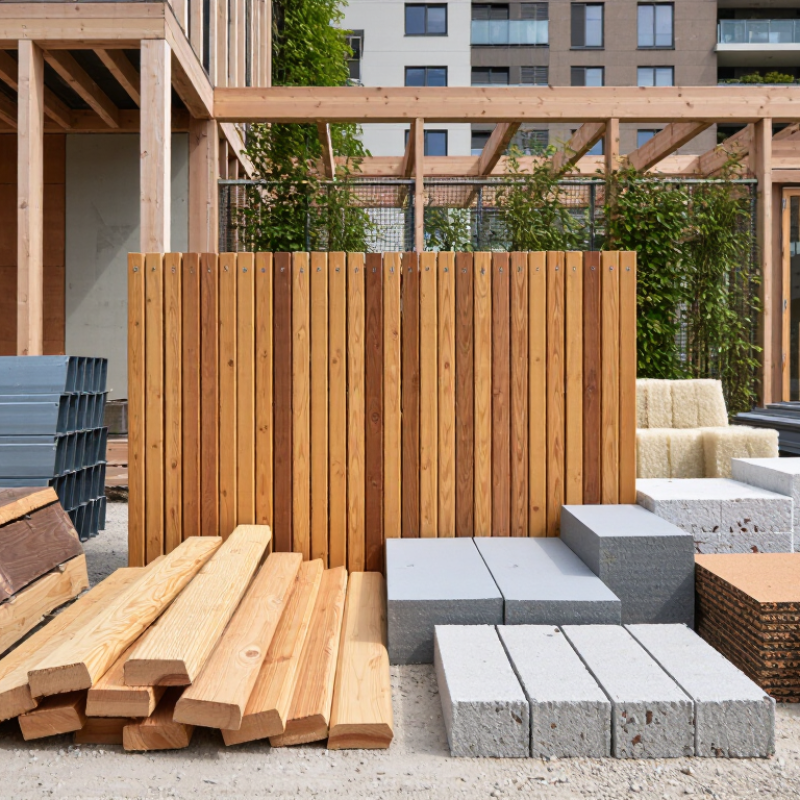
Low-Carbon Concrete: Cement Accounts for About 7% of Global CO₂ Emissions (IEA)
Concrete is everywhere: in foundation slabs, parking decks, and the gray stairwell outside an apartment. Its climate impact largely comes from cement, the binder that holds the mix together. The International Energy Agency estimates cement production contributes about 7% of global CO₂ emissions. That figure makes low-carbon concrete a practical priority, not a niche experiment.
One route is reducing clinker, the most emissions-intensive part of ordinary cement. Depending on local supply and engineering requirements, mixes may use materials such as calcined clay, limestone, or industrial by-products to replace some clinker. The result can be lower embodied carbon, but performance is not identical in every mix. Setting time, early strength, and curing needs may change. A contractor cannot simply swap materials and expect the same schedule.
For a real project, compare verified environmental product declarations and check what the figures include, especially transport and mix strength. Ask the design team to assess the concrete needed for the building’s actual loads and service life. More cement is not automatically safer. Still, low-carbon mixes can require testing, coordination, and patience; that part is easy to underestimate. A modest reduction, documented clearly, may be more dependable than a dramatic claim with no project-specific evidence.
What Are the Top Eco Friendly Building Materials in 2026?
| Material | Common Building Uses | Environmental Evidence | Low-Carbon Design Consideration | Reference |
|---|---|---|---|---|
| Low-carbon concrete | Foundations, slabs, structural frames, and infrastructure | Cement production accounts for about 7% of global CO₂ emissions, making cement content and production important areas for emissions reductions. | Specify suitable lower-clinker mixes where local standards and project requirements allow; assess strength, curing, durability, and whole-life performance. | International Energy Agency: Cement |
| Recycled-content steel | Beams, columns, reinforcement, roof structures, and connectors | Steel can be recycled repeatedly without losing its fundamental material properties. Its production emissions vary substantially with production route and energy source. | Request product-specific environmental product declarations (EPDs); prioritize efficient structural design and reuse where feasible. | World Steel Association: Steel Recycling |
| Timber and mass timber | Floor and roof systems, wall panels, framing, and interior finishes | Wood stores biogenic carbon while it remains in the product. The amount depends on species, density, moisture, product life, and end-of-life treatment. | Use responsibly sourced timber, design for long service life, and account for forest sourcing and end-of-life assumptions in whole-life assessments. | IPCC: Guidelines for National Greenhouse Gas Inventories, Volume 4 |
| Cellulose insulation | Insulation in walls, ceilings, and roof spaces | Cellulose insulation is commonly manufactured from recycled paper products, reducing reliance on newly produced raw material. | Check recycled content, fire and moisture specifications, installation quality, and the insulation’s performance for the local climate. | U.S. Department of Energy: Insulation |
| Reclaimed wood | Flooring, cladding, doors, interior elements, and some structural applications | Direct reuse can extend the service life of existing wood and reduce demand for newly harvested material. | Verify structural condition, previous coatings or treatments, dimensions, and suitability for the intended application. | U.S. EPA: Sustainable Management of Construction and Demolition Materials |
| Recycled aggregate | Road sub-base, fill, drainage layers, and certain concrete applications | Using suitable recovered construction materials can reduce demand for virgin aggregate and divert material from disposal. | Confirm grading, contamination limits, structural suitability, and local code acceptance; transport distance affects overall impacts. | U.S. EPA: Construction and Demolition Materials |
| Earth-based materials | Adobe and compressed-earth blocks, rammed-earth walls, and earthen finishes | These materials can require relatively little industrial processing when locally available and used without energy-intensive stabilization. | Evaluate soil suitability, weather protection, structural requirements, stabilizer content, and sourcing distance. | UNEP: Building Materials and the Climate |
Note: Environmental performance varies by product, manufacturing process, energy source, transport distance, building design, and service life. Compare project-specific EPDs and whole-life assessments where available; the examples above are not a universal ranking.
Related Posts
-
What Are Renewable Building Materials?
-

How to Choose Environmental Building Materials?
-

How to Source Renewable Building Materials in 2026
-
2026 Best Environmental Building Materials for Global Buyers
-
China Top Environmental Building Materials Manufacturers?
-
What Are the 2026 Top Sustainable Building Products?