
ROCKin'teriors
Eco-Friendly stone fabrication and installation
Natural beauty for your favorite space
Why Is My Forklift Battery Not Charging?
A forklift that refuses to charge can disrupt an entire shift. The cause may be simple: a loose connector, a damaged charging cable, or a charger that does not match the battery. It may also point to deeper trouble, such as worn cells, low electrolyte in a flooded battery, or a battery management system fault. A flashing charger light is a clue, not a diagnosis.
Start with what you can observe safely. Is the plug fully seated? Does the charger display an error code? Is the battery unusually hot, swollen, or leaking? Stop charging and contact a qualified technician if you notice heat, damage, or leakage. Never guess at voltage settings or bypass a charger fault. Small checks matter. So does patience.
A reliable diagnosis depends on battery type, charger compatibility, maintenance history, and measured readings. Record the battery model, charger model, error code, and recent operating symptoms before requesting service. These details help a technician narrow the cause without replacing parts unnecessarily. One limitation deserves attention: a battery that appears to charge may still have reduced capacity under load.
No source was provided for a named expert’s verified quotation, so attributing a direct quote would risk misleading readers. The guidance here is general; confirm model-specific procedures in the manufacturer’s manual or with a qualified Forklift Battery technician.
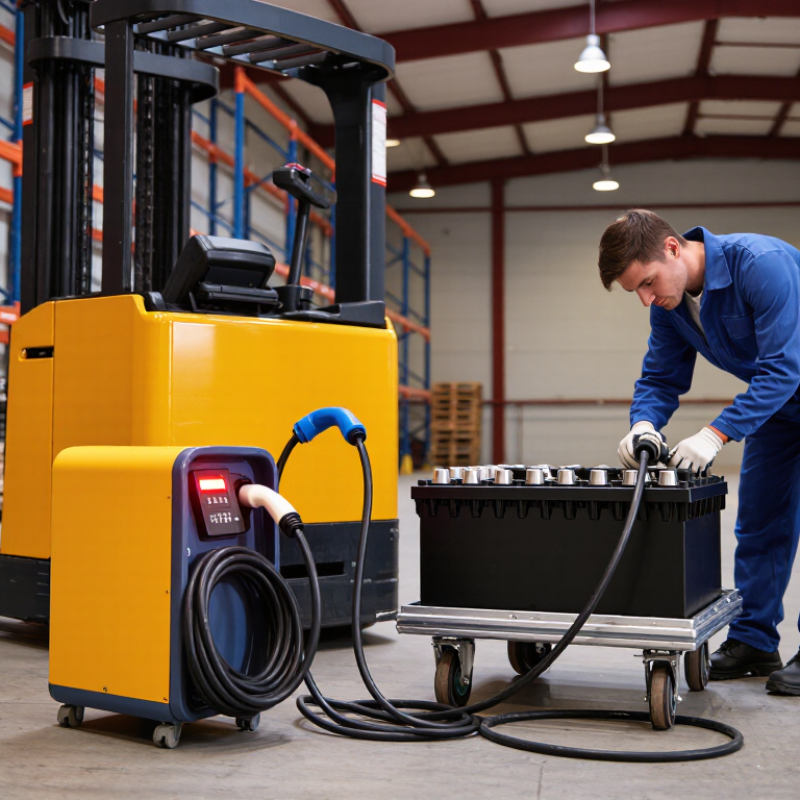
Forklift Battery Charging: Components and Normal Operation
A forklift charging circuit is a chain, not just a wall plug. The supply feeds a charger, which converts AC power into controlled DC for the battery. Cables, connectors, fuses, and the battery-management or monitoring system complete the path. On a lead-acid pack, the charger typically moves through bulk, absorption, and finish stages; the indicator may change even though charging is not complete. A common 48-volt pack has 24 cells. At roughly 2.4 volts per cell during absorption, the illustrative pack voltage is about 57.6 volts. Actual settings must match the battery specification. IEC 60254-1 sets test requirements for lead-acid traction batteries, while OSHA’s powered industrial truck standard requires designated battery-charging areas.
Normal charging also depends on temperature, state of charge, and sound connections. A warm connector, green corrosion, or a cable that feels loose can interrupt current before the battery itself fails. For a flooded lead-acid battery, check electrolyte level as instructed and keep vent openings clear; never assume a charger light proves the pack is healthy. DOE’s battery-charger test procedure distinguishes charging from maintenance-mode energy use, a reminder that chargers behave differently after the main charge. If the display shows charging but voltage barely rises, measure at the battery terminals and compare readings with the battery and charger manuals. That small check is easy to skip. I would, too, if the truck were needed immediately.
| Component or Check | Normal Operation | Possible Charging Problem | Practical Check |
|---|---|---|---|
| Battery pack | Stores electrical energy and accepts charging current when its condition, temperature, and state of charge are within the battery maker’s specified limits. | A deeply discharged, damaged, aged, or overheated battery may charge slowly, stop early, or fail to accept a charge. | Check the battery type, rated voltage, visible condition, temperature, and any fault indication. Use the battery manufacturer’s service procedure. |
| Charger and charge profile | Supplies a charging profile compatible with the battery chemistry and rated voltage. Many lead-acid chargers use controlled current followed by voltage regulation and a finishing stage. | An incompatible charger, incorrect settings, internal fault, or interrupted cycle can prevent charging or cause it to stop prematurely. | Confirm the charger is intended for the installed battery type and voltage. Read its status display and fault codes; do not substitute a charger based only on connector fit. |
| Power supply and outlet | Provides the input voltage and current required by the charger, as listed on its rating plate. | No supply, a tripped breaker, a damaged cord, or an unsuitable circuit can leave the charger inactive. | Check the supply connection and breaker where safe to do so. Have a qualified person inspect electrical faults; do not open energized equipment. |
| Charging connector and cables | Carry charging current through secure, correctly rated connections with clean, undamaged contacts. | Loose, corroded, contaminated, or heat-damaged contacts can interrupt charging or cause excessive resistance and heat. | With equipment safely isolated, inspect connectors and cables for looseness, discoloration, melting, or damage. Replace defective parts rather than bypassing them. |
| Battery management system (if fitted) | Monitors battery conditions and may permit, limit, or stop charging to protect the battery. | A protection event, communication issue, or detected cell imbalance may block charging or trigger a fault message. | Check the battery and charger displays for alerts. Follow the battery maker’s reset and diagnostic instructions; do not defeat safety interlocks. |
| Temperature and ventilation | Charging occurs within the battery and charger manufacturer’s allowed temperature range, with required airflow around equipment. | Excessive heat or cold may reduce charging performance or cause protective shutdown. Lead-acid batteries can release gas while charging. | Allow the battery to reach its permitted charging temperature. Keep ventilation openings clear and charge lead-acid batteries in a suitably ventilated area. |
| Lead-acid electrolyte and connections | For serviceable flooded batteries, electrolyte covers the plates as specified, and terminals are clean and secure. Sealed lead-acid types do not require routine water top-up. | Low electrolyte, dirty or loose terminals, or a damaged cell may reduce performance or interrupt charging. | Only inspect or service a flooded battery using the manufacturer’s procedure and appropriate protective equipment. Never open a sealed battery. |
| Charge completion and indicators | The charger indicates completion or a permitted maintenance state according to its design; charging time varies with battery capacity, discharge, temperature, and charger output. | An early completion indication may point to a connection issue, incorrect profile, battery fault, or charger fault. A timer alone does not confirm battery health. | Compare the charger’s status with the battery or truck display and the specified charging procedure. Record recurring faults for qualified service personnel. |
| Safe troubleshooting | Charging is carried out with compatible equipment and intact safety devices, following the operator and service manuals. | Repeated resets, bypassed interlocks, improvised adapters, or continued use of hot or damaged components can create shock, fire, or battery hazards. | Stop charging if there is smoke, unusual heat, sparking, swelling, leakage, or a strong abnormal odor. Isolate the equipment when safe and contact qualified service personnel. |