
ROCKin'teriors
Eco-Friendly stone fabrication and installation
Natural beauty for your favorite space
Top 10 Graphite Sheet Manufacturers for Global Buyers
A graphite sheet can look like a simple black layer, yet its performance depends on details buyers may not see in a product photo. Thickness, density, thermal conductivity, compressibility, and surface treatment all influence how it performs inside an electronic device, battery system, or industrial assembly. Supplier selection is therefore more than a price comparison. It is a materials decision.
Materials scientist Michael F. Ashby offers a useful design principle: “The choice of material is a key part of the design process.” For graphite sheet buyers, that means matching specifications to real operating conditions. Ask manufacturers how they verify thickness tolerance, thermal performance, and batch consistency. Request technical data, sample sheets, and clear information about customization. A sheet that handles heat well may still disappoint if it tears during converting or does not fit the assembly. Small details matter.
This guide reviews ten graphite sheet manufacturers serving global buyers, with attention to product range, production capabilities, quality controls, and communication. Not every supplier publishes the same level of technical evidence, so comparisons can be imperfect. That is worth admitting. A polished catalog is not proof of consistent production, and one sample cannot predict every future batch. Use the shortlist as a starting point, then verify specifications against your own application before placing an order.
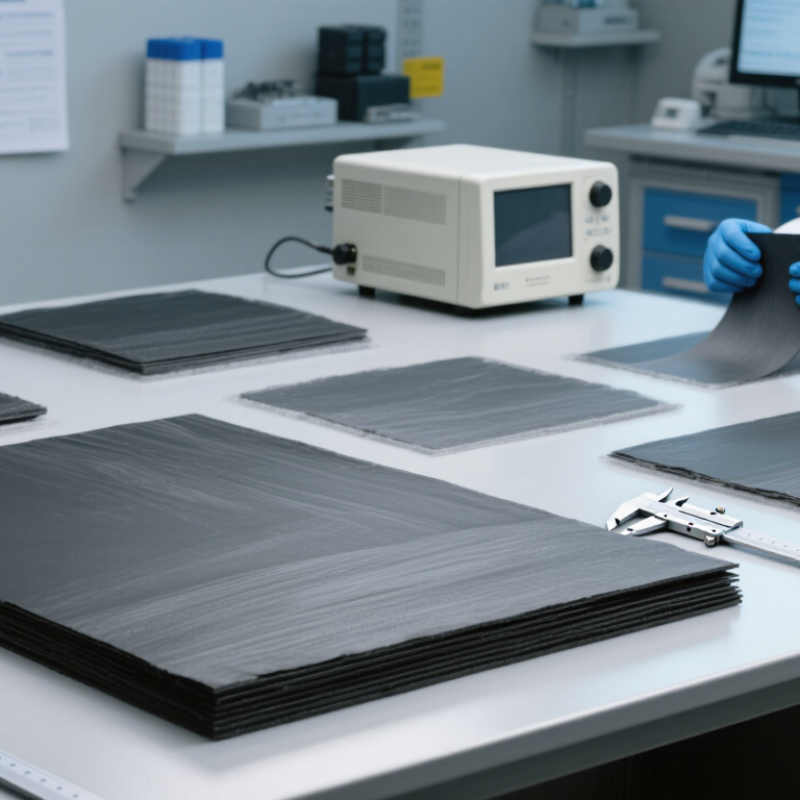
Graphite Sheets: Composition, Structure, and Common Forms
Graphite sheets are made from graphite, a form of carbon whose atoms sit in closely spaced layers. In flexible graphite products, natural graphite is expanded by heat and then compressed into thin sheets. The result is pliable, dark, and easy to cut. Some grades include binders or reinforcement, so composition is not identical across products.
Inside the sheet, graphite layers conduct heat and electricity more readily along their planes than through their thickness. This directional behavior matters when a sheet is used to spread heat from a small component across a wider surface. It is not magic. Contact pressure, surface finish, and thickness can all affect real performance.
Common forms include flexible graphite foil, reinforced sheets, and thermal graphite films. Foil bends around flanges and other uneven surfaces. Reinforced grades may contain metal foil or fibers to improve handling and strength. Thin thermal films are often used between electronic components and heat spreaders. Edges can shed particles, and a neat-looking sample does not guarantee the same performance in an assembly. Check the grade’s composition, thickness, and test conditions before comparing sheets. The details matter.
Top 10 Graphite Sheet Manufacturers for Global Buyers - Graphite Sheets: Composition, Structure, and Common Forms
Buyer-oriented overview of ten common graphite sheet product forms. Entries describe material types, not ranked manufacturers or brands.
| No. | Graphite Sheet Form | Composition and Structure | Typical Characteristics | Common Uses | Buyer Checkpoints |
|---|---|---|---|---|---|
| 1 | Unreinforced flexible graphite sheet | Expanded natural graphite flakes compressed into a flexible sheet; generally contains no reinforcing metal insert. | Conformable, compressible, and commonly supplied in sheet or roll form. | Industrial gaskets, seals, and thermal or electrical interface applications. | Confirm thickness, density, compressibility, purity, and temperature limits for the intended environment. |
| 2 | Metal-insert-reinforced graphite sheet | Flexible graphite layers combined with a metal reinforcement, often a perforated or tanged stainless-steel insert. | Reinforcement improves handling and resistance to blowout compared with unreinforced sheet. | Gaskets for piping, flanges, and equipment subject to pressure or mechanical handling. | Check insert material, corrosion compatibility, insert construction, and finished-sheet thickness. |
| 3 | Carbon-fiber-reinforced graphite sheet | Flexible graphite reinforced with carbon fibers or a carbon-fiber layer. | Provides added strength while retaining a graphite-based sealing surface. | Gaskets and sealing components where handling strength is important. | Ask for reinforcement details, tensile properties, and compatibility with the process media. |
| 4 | Adhesive-backed graphite sheet | A graphite sheet or foil supplied with a pressure-sensitive adhesive layer and release liner. | Adhesive simplifies placement; the adhesive layer may affect thermal, electrical, and temperature performance. | Thermal management, component assembly, and selected shielding applications. | Verify adhesive type, service temperature, outgassing requirements, and whether the adhesive is electrically insulating. |
| 5 | Natural-graphite heat-spreader sheet | Processed natural graphite formed into a thin sheet, often used as a planar heat-spreading material. | Graphite sheets can conduct heat more readily along the sheet plane than through its thickness. | Heat spreading in electronic devices and compact assemblies. | Compare in-plane and through-plane thermal data, thickness, flexibility, and electrical isolation needs. |
| 6 | Pyrolytic graphite sheet | Highly oriented graphite produced from a carbon precursor through high-temperature processing. | Strongly anisotropic thermal behavior: heat spreading is typically much greater in-plane than through-plane. | Thin thermal spreaders in electronics and precision thermal-control assemblies. | Check orientation, thickness, handling limits, surface protection, and the supplier’s test method for thermal data. |
| 7 | Graphite–polymer composite sheet | Graphite particles or flakes dispersed in a polymer matrix; composition and filler loading vary by grade. | Properties depend on the polymer, graphite content, and filler orientation; some grades are electrically conductive. | Thermal interface parts, conductive components, and molded or cut-to-shape applications. | Request thermal and electrical properties, polymer compatibility, hardness, and operating-temperature range. |
| 8 | Graphite sheet laminated to a metal carrier | A graphite layer bonded or laminated to a metal backing, rather than simply containing an internal insert. | The carrier adds support and can make the graphite layer easier to handle or integrate. | Specialized gaskets, heat-transfer assemblies, and supported sheet components. | Check bonding method, metal grade, carrier thickness, corrosion risk, and thermal-expansion compatibility. |
| 9 | Rigid graphite plate or sheet | Machined or cut from a rigid graphite block; grades may differ in grain size, density, and manufacturing route. | Stiffer than flexible graphite sheet and available in plate formats for machining. | Fixtures, furnace components, electrodes, and other applications selected for the specific graphite grade. | Specify dimensions, tolerances, grade, porosity or density requirements, and the operating atmosphere. |
| 10 | Graphite paper | Thin sheet made from graphite flakes or fibers; porosity, density, and surface finish depend on the product. | Lightweight and thin, with performance that varies substantially between grades. | Laboratory, filtration, electrode, and other specialty applications where the selected grade is suitable. | Confirm thickness, basis weight or density, porosity, purity, and intended-use compatibility. |
| Note: Graphite sheet properties vary by grade, manufacturing process, thickness, reinforcement, and test method. Treat descriptions as general product-form guidance and confirm specifications with the supplier before purchasing. | |||||