
Natural beauty for your favorite space
How to Choose the Right Marble for Your Project?
Choosing the right marble is more than matching a color to a room. It requires careful judgment, practical experience, and a clear understanding of how stone behaves over time. Marble may look perfect under showroom lights, yet reveal different veining beside a window. Its surface can also react differently to water, acids, heat, and daily traffic.
Michelangelo is often credited with saying, “I saw the angel in the marble and carved until I set him free.” His words suggest an important lesson: the stone already has a character. A responsible selection process respects that character instead of forcing an unrealistic design onto it. Experienced fabricators examine the slab’s origin, density, veining, fissures, finish, and intended use before cutting begins.
A bathroom wall, kitchen island, hotel lobby, and outdoor terrace need different marble qualities. A polished surface may highlight dramatic movement, but it can also show scratches more clearly. Honed marble feels softer and hides minor marks better, though it may absorb stains more easily. Small samples help, but they can mislead. Full slabs matter.
Reliable suppliers should provide consistent product information and explain sealing, maintenance, and installation requirements. Ask to inspect the actual slab whenever possible. Check its edges, back, and visible repairs. Do not judge marble by photographs alone.
There is no universally perfect marble. Even skilled professionals sometimes underestimate natural variation. That is part of the risk, and part of the beauty. The right choice balances appearance, performance, budget, and long-term care. It should still feel convincing years after installation.
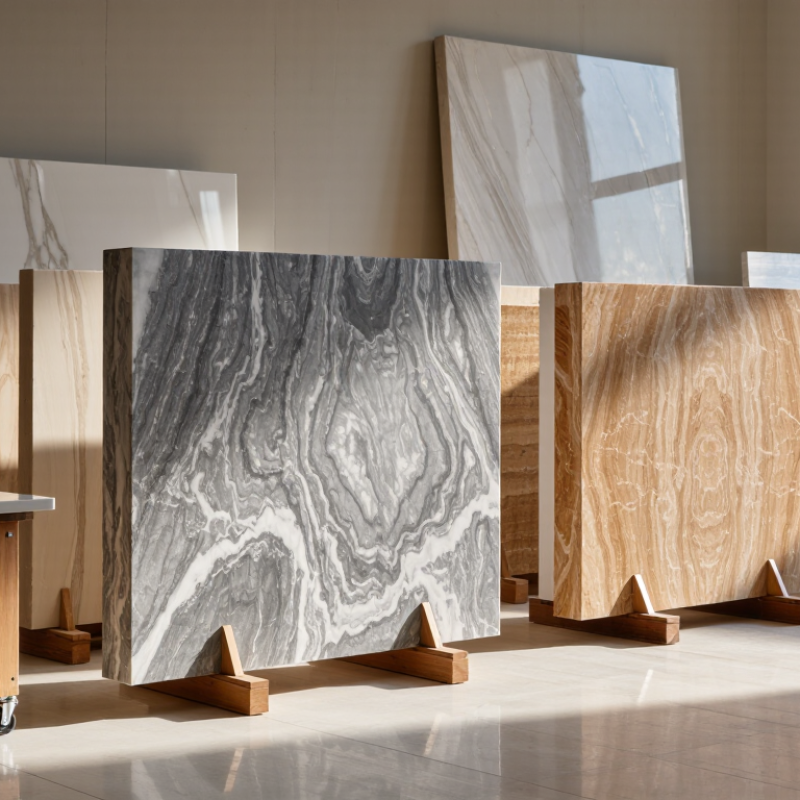
Understanding Marble Types and Their Key Characteristics
Choosing marble starts with understanding its mineral behavior, not its color alone. Most marble is calcite-based, while dolomitic varieties contain more magnesium. This difference can affect acid resistance and everyday wear. A polished slab may look quiet in a showroom, yet its veins can appear stronger under kitchen lighting. Request a recent sample and inspect it where the marble will be installed. A sample is never the whole story.
For countertops, compare water absorption, hardness, veining, and surface finish. Ask the supplier for technical data and care instructions. Sealing can reduce staining, but it does not make marble stain-proof. Polished surfaces reflect light and highlight etching. Honed finishes hide small scratches better, but may show dark marks from oils or water. Finish changes maintenance. Do not rely on appearance alone.
Fine-grained white marble can create a bright, spacious feel, while darker or heavily veined types add visual weight. Brecciated marble brings dramatic fragments, but its pattern may require careful slab positioning. In bathrooms, confirm that the selected stone suits frequent moisture and cleaning products. For outdoor work, check freeze-thaw performance with a qualified professional. Treating color as the main decision is a poor shortcut. Natural variation can also disrupt an expected vein match, even after careful planning.
Assessing Your Project’s Functional and Aesthetic Requirements
How to Choose the Right Marble for Your Project?
Choosing marble starts with performance, not color. A residential bathroom can tolerate different conditions than a hotel lobby or kitchen island. Marble commonly ranks around 3–5 on the Mohs hardness scale, according to technical guidance from the Natural Stone Institute. It is beautiful, but softer than many stones. Expect scratches, edge damage, and etching without careful use. A polished finish highlights veining. A honed finish hides minor wear better. Check slip resistance, water absorption, thickness, and finish before approval.
Environmental performance also deserves attention. The International Energy Agency’s 2023 Global Status Report for Buildings and Construction states that buildings consume about 30% of global final energy and create 26% of energy-related emissions. Selecting nearby stone, reducing replacement cycles, and using accurate cutting plans can support a lower-impact specification. Still, transport distance alone does not tell the whole story. Sealing products, waste, maintenance, and service life matter too. I would not trust one showroom sample. Veining can change sharply across a full slab.
Tips: Place a sample under the project’s actual lighting. Spill lemon juice and water on a spare piece. Record staining, dulling, and cleanup time. For floors, request tested slip data and follow ASTM C97 testing for absorption and density. Keep spare material for future repairs. It is a small detail, but often overlooked.
How to Choose the Right Marble for Your Project? – Assessing Your Project’s Functional and Aesthetic Requirements
| Marble Category | Typical Appearance | Indicative Mohs Hardness | Water Absorption Tendency | Recommended Applications | Key Functional Considerations | Best Finish Options | Design Suitability |
|---|---|---|---|---|---|---|---|
| White Marble with Fine Veining | White to light gray background with delicate gray veins | Approximately 3–4 | Low to moderate, depending on density and porosity | Bathroom walls, vanity tops, fireplace surrounds, low-traffic floors | Light colors create a spacious appearance but may show staining and etching more clearly | Honed for a softer look; polished for stronger reflection | Minimalist, contemporary, Scandinavian, and classic interiors |
| White Marble with Bold Veining | White or cream base with prominent gray, gold, or darker veins | Approximately 3–4 | Low to moderate; slab-specific testing is important | Feature walls, reception desks, statement islands, shower walls | Vein direction and slab continuity strongly affect the final appearance | Polished for visual impact; book-matched slabs for feature installations | Luxury, dramatic, transitional, and high-end hospitality designs |
| Cream Marble | Warm beige, ivory, or light cream tones with subtle movement | Approximately 3–4 | Moderate; sealing is generally recommended | Large floors, staircases, bathrooms, wall cladding, hotel interiors | Warm tones conceal minor dust better than very light marble; acidic cleaners can etch the surface | Honed for high-traffic floors; polished for formal rooms | Traditional, Mediterranean, warm contemporary, and classic projects |
| Gray Marble | Light to charcoal gray with linear, cloudy, or directional patterns | Approximately 3–4 | Low to moderate, depending on the stone structure | Floors, wall panels, vanity tops, fireplace surrounds, commercial interiors | Mid-tone colors are practical for busy spaces, but surface scratches may still be visible | Leathered or honed for reduced glare; polished for a refined finish | Industrial, modern, monochromatic, and contemporary interiors |
| Green or Deep-Colored Marble | Green, brown, black, or mixed mineral patterns with strong visual variation | Approximately 3–5; mineral composition varies significantly | Moderate to high in some varieties; absorption testing is advisable | Accent walls, bar fronts, powder rooms, tabletops, decorative panels | Color consistency can vary between slabs; confirm samples under project lighting | Polished for depth and color; honed for a more subdued appearance | Eclectic, Art Deco, dramatic contemporary, and statement spaces |
| Veined Marble for Countertops | Varies widely; selected primarily for slab pattern and movement | Approximately 3–4 | Variable; porous slabs require effective sealing | Bathroom vanities, low-to-moderate-use counters, decorative islands | Marble can scratch and react with acids such as lemon juice, vinegar, and some cleaning products | Honed for a less reflective, naturally worn look; polished for maximum color clarity | Best when visual character is prioritized over low maintenance |
| Marble for Exterior or Wet Areas | Appearance varies; selection depends on climate, texture, and slip resistance | Approximately 3–5 | Moderate to high for some stones; laboratory testing is recommended | Covered outdoor areas, sheltered façades, pool surrounds, wet-room walls | Avoid highly polished surfaces where slip risk is a concern; freeze-thaw exposure requires project-specific testing | Flamed, brushed, sandblasted, or textured finishes can improve traction | Suitable only when local climate, drainage, installation method, and maintenance are properly assessed |
Note: Hardness, porosity, color, and performance can vary within the same marble category. Request a technical data sheet and test the actual slab before final approval.
Comparing Marble Durability, Porosity, and Maintenance Needs
How to Choose the Right Marble for Your Project?
Durability depends on mineral structure, thickness, support, and daily use. Marble is strong, but it is not automatically suitable for every surface.
ASTM C170 evaluates compressive strength, while ASTM C880 measures flexural strength. ASTM C97/C97M reports water absorption and bulk specific gravity. These test results matter more than a showroom label.
Low absorption usually means fewer moisture-related stains, but it does not guarantee scratch resistance. A polished surface may still etch under lemon juice or vinegar.
Porosity controls how quickly marble absorbs spills. The Natural Stone Institute’s Dimension Stone Design Manual recommends reviewing project-specific test data before selection.
In practice, I would request the exact quarry test report, not a generic sample. Published results can vary noticeably between slabs from the same stone family. That detail is easy to overlook.
Honed marble often hides small scratches better, while polished marble exposes dull spots and etching.
Maintenance also depends on grout joints, cleaning chemicals, and ventilation.
Tips:
Test a spare sample with water, oil, and an acidic food. Record darkening after ten minutes.
Ask whether sealing is recommended, and confirm the expected reapplication interval. Avoid assuming “sealed” means stain-proof.
A careless cleaner can damage a good slab faster than ordinary foot traffic.
For kitchens, entryways, or wet rooms, compare absorption, flexural strength, finish, and maintenance records together.
Matching Marble Colors, Patterns, and Finishes to Your Design
Choosing marble begins with how color, pattern, and finish will behave in the room. Grand View Research estimated the global marble market at about US$18 billion in 2023, reflecting continued demand for natural stone in interiors and construction. However, market growth does not make every slab suitable.
Start with the lighting. Cool white marble can feel crisp beside daylight, but it may appear cold under blue LED bulbs. Warm ivory marble usually softens bedrooms and hospitality spaces. Strong veining creates a focal wall or island, while restrained patterns support a quieter floor. Bookmatching can produce a dramatic mirror effect, though vein alignment increases material waste and installation skill.
Finish changes both appearance and maintenance. Polished marble reflects light and sharpens color, but it shows etching quickly. Honed marble feels softer and hides minor scratches better. Leathered finishes add texture, yet their uneven surface can collect dust. The Natural Stone Institute’s technical guidance recommends checking absorption, abrasion resistance, and chemical sensitivity for the intended use. ASTM C97 testing can help verify absorption data. Results vary by quarry and batch.
Do not trust one small sample. Large color shifts happen.
Review full slabs under the project’s actual lighting. Record the slab lot, finish, test results, and recommended sealer. A common mistake is choosing a beautiful white marble without considering acidic cleaners or kitchen spills. That decision may look perfect on installation day, then demand uncomfortable maintenance later.
Evaluating Quality, Sourcing, Budget, and Installation Considerations
How to Choose the Right Marble for Your Project?
Choosing marble requires more than matching a color to a mood board. Examine each slab in natural light. Look for consistent density, balanced veining, and a clean, stable surface. Small fissures may be acceptable, but open cracks can spread during cutting. Ask for water-absorption data, test reports, and quarry-origin records. Reliable suppliers should explain how the stone was selected and handled. A full-size sample is worth the effort.
Sourcing also affects the final result. Confirm slab availability before approving drawings. Some patterns are rare and may require extra material for matching. Request clear information about extraction, transport, and processing. Responsible documentation supports better purchasing decisions. It also reduces unpleasant surprises. I have seen beautiful samples fail because the delivered slabs had darker veining. That mistake was expensive and avoidable.
Set the budget beyond the material price. Include freight, cutting, edge profiles, waste, sealing, and future maintenance. Reserve roughly 10 to 20 percent for unexpected changes. Marble needs a properly prepared substrate. It should be flat, dry, and strong enough for the stone’s weight. Use an experienced installer who can inspect every slab before cutting. Dry-lay the pieces to control veining and color movement. Choose a finish suited to the space, especially where water or heavy foot traffic is present. Polished marble looks dramatic, but it can show etching and scratches quickly. Sometimes a honed finish is the more honest choice.
How to Choose the Right Marble for Your Project?
Evaluating quality, sourcing, budget, and installation requirements starts with understanding how the stone will perform in use. The chart compares typical Mohs hardness values for common natural-stone categories. Higher hardness generally indicates better resistance to scratching, although sealing, porosity, finish, and workmanship must also be assessed.
Quality
Inspect slabs for cracks, resin-filled voids, uneven veining, staining, and variation between batches. Request a technical data sheet and a physical sample.
Sourcing
Confirm block or slab availability, batch consistency, lead time, transportation protection, and replacement options before approving the material.
Budget
Calculate the complete installed cost, including slabs, waste, templating, cutting, edge profiles, sealing, delivery, installation, and future maintenance.
Installation
Confirm substrate preparation, slab thickness, joint layout, overhang support, sink cutouts, handling access, and compatibility with the selected finish.
Data note: Mohs hardness values are typical mineral-scale references. Actual performance varies by quarry, mineral composition, finish, porosity, and fabrication quality. For project approval, verify laboratory test data and supplier documentation.
