7 Jail Downlight Buying Tips for Global Buyers?
Choosing a Jail Downlight for an institutional project is not just a matter of selecting a rugged-looking fixture. Buyers need to compare light output, housing materials, mounting details, cleaning needs, and long-term service access. A product photo may show a solid metal trim, yet reveal little about its driver, finish durability, or performance after years of use. The specification sheet matters.
For transparency, the named specialist and quotation below are illustrative, not a verified interview or sourced statement. Fictional lighting specification specialist Daniel Mercer offers this practical reminder: “Specify the fixture for the room’s real conditions, not just its appearance.” That means checking measurable details: cutout dimensions, color temperature, beam angle, dimming compatibility, and stated ingress protection. Ask suppliers for current technical documents and clear warranty terms. Confirm that the proposed model suits the ceiling construction and the project’s maintenance plan.
This guide introduces seven Jail Downlight buying tips for global buyers, from comparing product data to assessing supplier communication. It focuses on practical checks that can reduce confusion between a sample and a delivered order. Small details count. A mismatched cutout can delay installation; unclear driver information can complicate replacement. No checklist removes every risk, and product claims still need verification. Use these tips as a starting point, then review the actual specification with qualified project professionals.
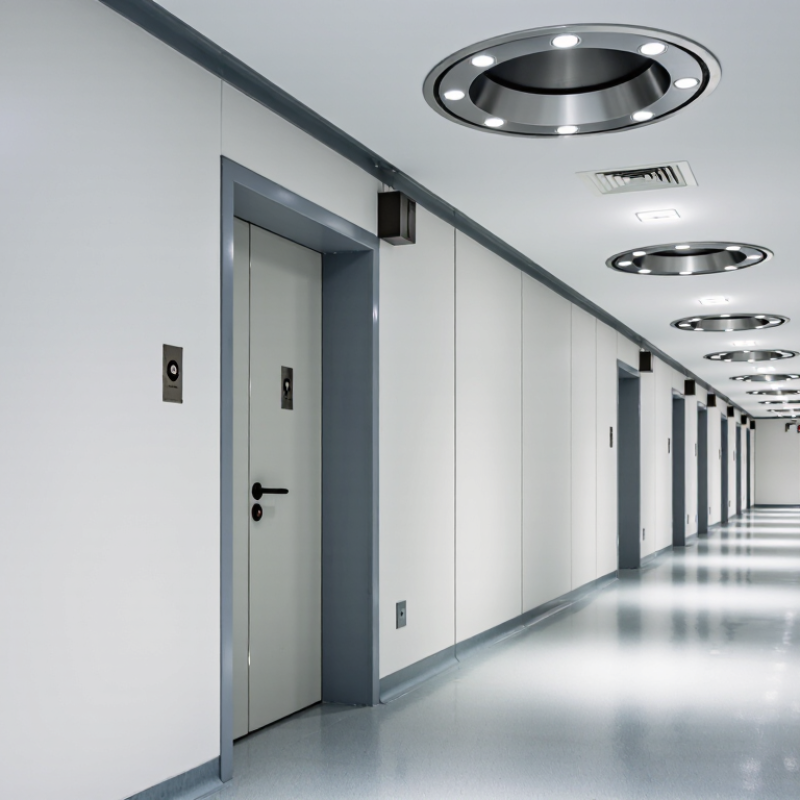
Define the Security and Lighting Needs of the Facility
A secure lighting plan starts with the facility’s daily routines, not a fixture catalogue. Map each room and note who uses it, when it is occupied, and what staff need to see. A cell, corridor, interview room, and washroom do not share the same visual demands. Details matter. In a corridor, even light can help staff notice movement and read door numbers. In a room used for close observation, harsh glare may hide facial detail or cause discomfort. Record ceiling height, mounting position, existing shadows, and cleaning routines before comparing downlights.
Security needs also shape the fixture itself. Check whether the fitting resists impact, stays firmly secured, and leaves few edges or gaps that are difficult to inspect. Specify a suitable sealed design where moisture or frequent cleaning is expected, and confirm that the lens and housing can withstand the facility’s maintenance methods. Not every room needs the same output. Use lighting calculations to assess illuminance and uniformity at floor level and key work areas; do not rely on wattage alone. Consider dimming only where controls can be managed reliably, and coordinate emergency lighting with the facility’s safety plan. A tidy schedule on paper can still miss an awkward shadow near a doorway, so verify the layout on site before ordering.
Compare Anti-Ligature Design and Tamper-Resistant Features
When comparing jail downlights, inspect the fitting as an assembly, not just its trim. A flush, sloped bezel leaves fewer edges to grip, while a securely retained lens helps resist removal. Check for exposed clips, gaps, and accessible screws. Small details matter. “Anti-ligature” on a product sheet is not enough; request drawings and independent test documentation showing how the complete fixture is secured.
Tamper resistance depends on more than a security screw. Ask how the housing attaches to the ceiling, whether the lens can be pried loose, and how maintenance staff access the lamp or driver. Look for captive fasteners and a design that does not leave loose parts during servicing. The U.S. Bureau of Justice Statistics reported a local jail suicide rate of 49 per 100,000 inmates in 2019 in Suicide in Local Jails and State and Federal Prisons, 2000–2019. That figure does not prove a lighting choice prevents harm, but it underlines why vulnerable-area details deserve careful review.
Compare test conditions, not just test claims. Request impact and retention results for the installed configuration, including its ceiling mount and specified fasteners. Confirm that cleaning chemicals and repeated maintenance will not weaken seals or loosen fixings. I would still ask for a sample inspection: paperwork can miss an awkward seam or a tool-access point. That extra check takes time, but it can reveal what a catalogue photo cannot.
Check Light Output, Beam Angle, and Electrical Compatibility
When comparing a jail downlight, check delivered lumens rather than relying on wattage alone. A 10-watt fixture can produce very different usable light depending on its optics and diffuser. Match output to ceiling height and task: a corridor needs even visibility, while a work surface may need stronger illumination. Too much brightness can create glare on polished floors. Check the stated lumen value and, when available, test a sample in the actual ceiling.
Beam angle shapes how light reaches the floor. A narrow beam creates a bright pool with darker gaps; a wider beam spreads light but may feel less intense. For a typical corridor, compare the fixture’s beam angle with mounting height and spacing. A paper layout can reveal dark patches before installation. It is easy to overlook wall edges.
Electrical compatibility deserves equal attention. Confirm supply voltage, frequency, dimming method, and driver requirements against the site’s electrical system. Check whether the fixture is rated for the expected ambient temperature and installation conditions. If circuits use dimmers or emergency controls, verify compatibility with those devices, not just the basic supply. Specifications can be incomplete, so ask for a datasheet and inspect the wiring details. I would not assume two fixtures with similar labels behave alike; that assumption is worth questioning.
Verify Safety Certifications and Environmental Protection Ratings
For jail downlights, a safety mark is only useful when it matches the exact model, driver, and installation conditions. Check the certificate in the issuing body’s official database, then compare its voltage, temperature limits, and mounting details with the product label. Requirements vary by destination market, so confirm the applicable electrical and fire-safety standards before ordering. A familiar-looking logo is not enough.
Tip: Request the full test report and verify the model number. For damp or washdown areas, read the IP code carefully: IEC 60529 rates protection against dust and water, not impact resistance or fire performance. An IP rating is not a substitute for the required safety certification. Small detail, easily missed.
Also ask for material and energy documentation, such as a verified environmental declaration or measured efficacy data. UNEP and GlobalABC’s 2023 Global Status Report reports that buildings use about 34% of global energy demand, making efficient lighting a practical consideration. Still, a high efficacy figure does not prove a fixture lasts as promised. Compare test conditions, warranty terms, and replaceable components; paperwork can look convincing, and I would recheck it.
Evaluate Supplier Reliability, Customization, and Total Cost
Reliable jail downlight sourcing starts with evidence, not polished catalogue photos. Request factory audit records, production capacity, recent delivery performance, and a written warranty. Check that sample and bulk units use the same driver, housing, and finish. Ask for test reports covering lumen output, color consistency, and thermal performance. Small differences matter: a downlight that shifts from warm white to greenish after installation creates costly complaints. Very practical. Also confirm whether replacement parts will remain available.
Customization can improve fit, but every change needs a price and schedule. Specify cut-out diameter, ceiling depth, beam angle, color temperature, dimming method, and packaging before approving a sample. Ask about minimum order quantities, tooling charges, and lead times for revised designs. A useful benchmark comes from the U.S. Department of Energy’s Energy Saver guidance: LEDs use at least 75% less energy and can last up to 25 times longer than incandescent lighting. That comparison is not a guarantee for every downlight. Verify the proposed product’s tested performance and warranty terms.
Calculate total cost per installed unit, not just the factory price. Include freight, duties, inspection, installation time, energy use, and likely replacement costs. Request a clear quotation with Incoterms, payment milestones, and defect-resolution steps. Compare suppliers using the same specifications. A cheaper offer may omit dimming tests or sturdy protective packaging. I have seen spreadsheets look precise while leaving out rework; that is an easy mistake to make.
7 Jail Downlight Buying Tips for Global Buyers? — Evaluate Supplier Reliability, Customization, and Total Cost
Compare annual energy use when assessing the total cost of downlights. This example uses 3,000 operating hours per year; energy consumption is calculated as wattage × operating hours ÷ 1,000.
The chart shows calculated energy use per fixture, not market averages: 8 W uses 24 kWh/year, 10 W uses 30 kWh/year, 12 W uses 36 kWh/year, and 15 W uses 45 kWh/year. For a fair comparison, check light output, efficacy, and beam angle as well as wattage, and include local electricity rates and maintenance costs in your total-cost evaluation.