How to Choose the Right Permanent Formwork Magnet?
Choosing a Permanent Formwork Magnet is a practical decision, not a catalogue exercise. The right unit must hold the form securely against a steel casting table, resist movement during concrete placement, and release without damaging the formwork. A few millimetres of misalignment can matter. Small details matter.
The wider construction context reinforces the need for dependable equipment. The 2024 Global Status Report for Buildings and Construction, published by the UN Environment Programme and GlobalABC, estimates that buildings and construction account for 32% of global energy use and 34% of energy- and process-related carbon dioxide emissions. Those figures do not measure magnet performance, but they underline why efficient, repeatable precast production deserves careful attention. Compare magnet dimensions, rated holding force, table condition, coating, release mechanism, and the loads created by your specific mould. Treat catalogue ratings as a starting point; dust, surface gaps, vibration, and uneven steel can change real-world performance. I have not added a named expert quotation because no source was provided to verify one. Assigning an invented sentence to a specialist would weaken the reliability this guide should offer. The useful question is not simply which magnet is strongest, but which one performs consistently in your setup—and where the evidence still needs checking.
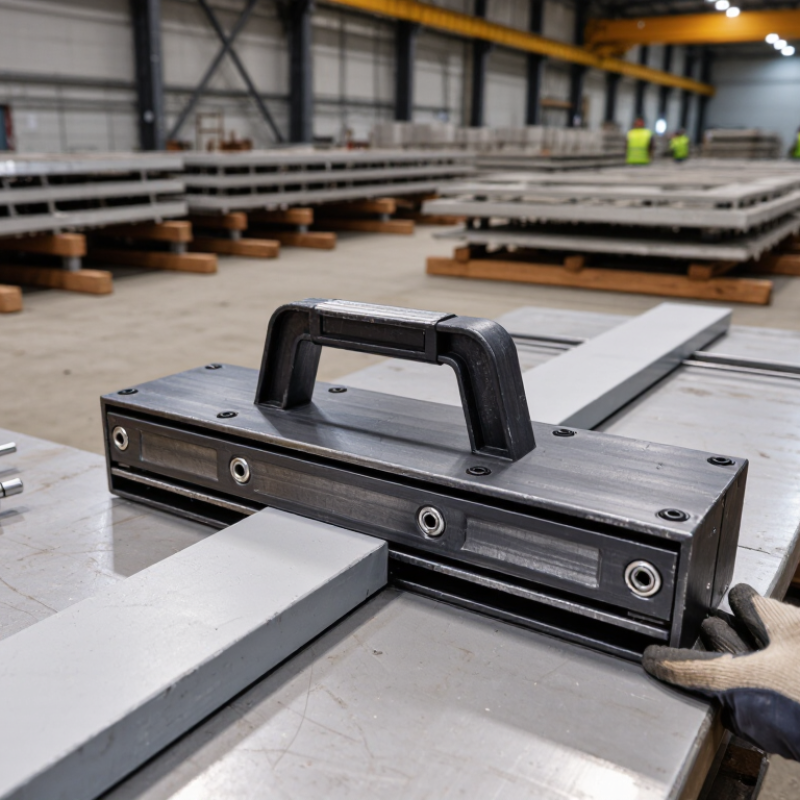
What Is a Permanent Formwork Magnet and How Does It Work?
How to Choose the Right Permanent Formwork Magnet?
What Is a Permanent Formwork Magnet and How Does It Work?
A permanent formwork magnet is a compact fixture used to hold steel side forms on a steel casting table during precast concrete production. Its magnetic force keeps the form in position while concrete is placed and cured. Unlike an electromagnet, it does not need a continuous electrical supply. No wiring is needed. The magnet usually has a lever or button that changes its magnetic circuit, switching the holding force on or releasing it.
In use, an operator places the magnet flat against the table and connects it to the formwork. Clean, even contact matters: dried concrete or a small gap can reduce holding performance. Once activated, the magnet resists movement from concrete pressure and routine vibration, but it is not a substitute for checking the whole setup. Form height, concrete depth, vibration, table condition, and magnet spacing all affect the load. A unit that feels strong by hand may still be unsuitable for a particular pour. That part is easy to underestimate.
Tips: Check the rated holding force and the manufacturer’s placement guidance. Test the arrangement on the actual table before production, and inspect contact surfaces for debris or wear. If the form shifts, stop and reassess the setup rather than simply adding magnets.
How Should You Match Magnet Force and Design to the Job?
Choosing magnet force starts with the load path, not a catalogue number. ACI 347R-14 links fresh-concrete pressure to placement rate, temperature, mix properties, and vibration. As a simple hydrostatic check, normal-weight concrete at about 150 lb/ft³ creates roughly 23.5 kPa of pressure per metre of concrete depth. That load acts on the form face, then transfers through ribs and brackets to the magnets. Small detail, big consequence. A strong magnet cannot compensate for a flexible panel or poor contact with the steel bed.
Match the magnet layout to the actual panel spacing, pour height, and expected placing speed. ACI 237R-07 reports a typical slump-flow range of 18–32 inches for self-consolidating concrete; its high flow can make conservative pressure assumptions especially important. Allow for uneven load sharing, surface gaps, and vibration, then verify the supplier’s rated holding force under comparable contact conditions. Pull-off ratings on clean, flat steel may not reflect a dusty or slightly warped production table. I would test one representative setup before committing to a full layout. It is easy to underestimate the edge magnets. Check them again.
What Materials and Site Conditions Affect Magnet Performance?
Permanent formwork magnet performance depends on both the magnet and the steel it grips. Thick, clean steel usually provides a better magnetic path than thin sheet metal. Paint, rust, welding scale, or dried concrete can create a small gap and reduce holding force. Even a thin layer matters. Check the contact face, not just the magnet’s rated pull.
Site conditions can change the result. Uneven formwork may leave only part of the magnet touching the table, while vibration can loosen a poorly seated unit. Moisture itself is not usually the main concern, but wet cement paste and grit can collect beneath the magnet. High temperatures may also reduce force if they exceed the magnet’s rated range. A strong magnet cannot fix a bad setup. Test it on the actual table and formwork; ratings alone can be misleading.
Tips: Wipe contact surfaces before installation. Check steel thickness and flatness, then inspect magnets after concrete placement. If one shifts, look for debris or a poor fit before choosing a stronger unit. This check takes time, but skipping it can be an expensive assumption.
How Can You Check Installation, Safety, and Reuse Requirements?
Before installation, compare the magnet layout with the formwork drawings and the panel maker’s load data. Check that the steel contact face is clean, flat, and free of hardened concrete, oil, or loose scale. Small details matter. Confirm each magnet sits fully against the panel and that its locking mechanism engages without force. Do not guess. Verify spacing and holding capacity for the actual panel thickness, concrete pressure, and expected vibration; a rating from a different setup may not apply. A brief trial on a sample panel can reveal rocking or uneven contact, but it does not replace the specified engineering checks.
During placement and removal, keep hands clear of pinch points and use the intended release method. Never pry a magnet loose while the formwork is loaded. Inspect the panel and attachment points for movement before pouring, and pause if anything shifts. In practice, site conditions rarely match a neat drawing, and rushed checks can miss a small gap. That deserves a second look. For reuse, remove concrete residue with a method that will not gouge the contact surface, then inspect for cracks, corrosion, bent parts, or a weak locking action. Record damaged units and set them aside until assessed. Store serviceable magnets dry, with contact faces protected; repeated use is sensible only when inspection confirms reliable engagement.