How to Choose the Best PVDF Air Dome for Your Project
Choosing the right Pvdf Air Dome begins with the project, not a product brochure. A sports facility, temporary event venue, and covered warehouse place different demands on the structure. Start with the clear span, expected occupancy, operating season, and available installation area. Then consider local wind, snow, rain, and temperature conditions. These details shape the design brief.
The membrane deserves close attention. Ask for its construction, coating, seam method, and documented performance data. Compare those details with the supplier’s stated design assumptions, rather than relying on a single strength figure. Check how the anchoring system suits the ground, and where doors, lighting, ventilation, and emergency exits will sit. Small layout choices matter. A doorway exposed to prevailing wind may affect daily use.
The air-support and climate systems also need practical review. Confirm how pressure is monitored, what backup power is planned, and who handles routine inspections. Request drawings, maintenance guidance, and examples of comparable projects. A technically impressive dome can still be a poor fit if service access is awkward or energy demands exceed the operating budget. No choice is perfect. Even careful comparisons leave questions, especially when project conditions change. Use this guide to assess materials, engineering, installation, operation, and supplier support before making a decision. The aim is not simply to find the lowest quote, but to choose a structure that fits its site and intended use.
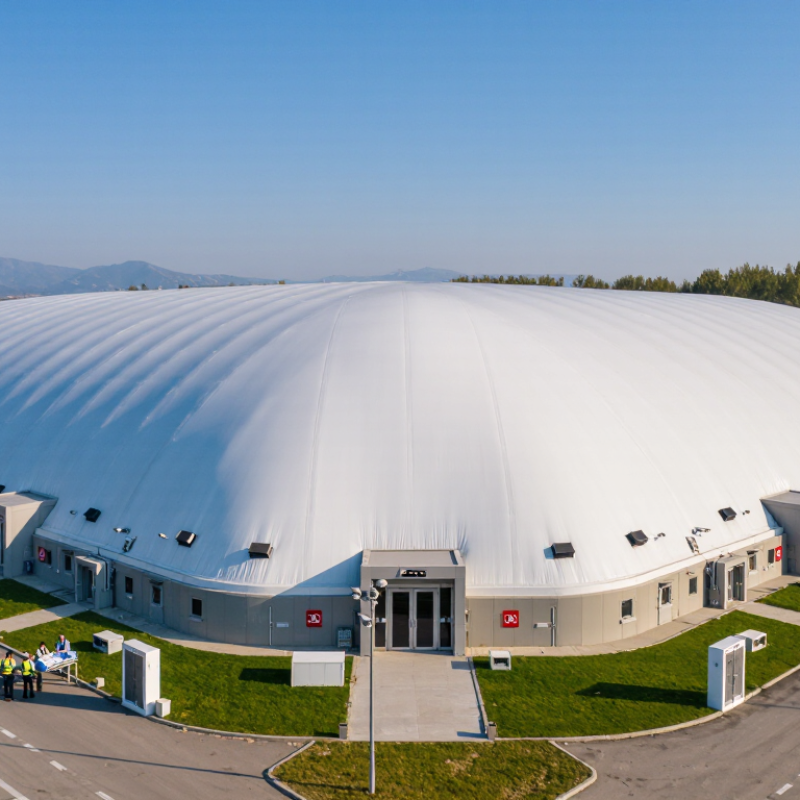
Define Your Project’s Purpose, Size, and Site Requirements
Define what the dome must do before comparing fabric or layouts. Will it shelter sports, storage, events, or year-round operations? Each use changes the clear-span, ventilation, lighting, and access needs. Estimate normal occupancy, then allow room for equipment, walkways, and safe exits. A court that fits on paper may feel cramped once benches and nets are added. Plan for likely changes, but avoid paying for unused space.
Measure the site, not just the proposed footprint. Check ground slope, drainage paths, soil conditions, vehicle access, and nearby trees or structures. Wind and snow exposure can affect the dome’s frame, anchoring, and foundation design. Share local site data with a qualified design professional, and confirm that the proposed system suits those conditions. A common planning miss is overlooking service access; repairs become harder when trucks cannot reach the entrance. Even a careful sketch can miss something.
Tips: Mark the dome corners with stakes, then walk the intended routes. Note where doors, lights, and utilities should go. Ask for load assumptions in writing, and revisit them if the site plan changes.
Compare PVDF Membrane Properties and Performance Ratings
Choosing a PVDF air dome starts with the membrane test report, not its surface gloss. Compare coated-fabric tensile strength in both warp and weft directions, using ISO 1421 or ASTM D751 results. As a preliminary screen, a project team might request at least 4,000 N per 5 cm in each direction; this is a procurement target, not a universal code requirement. Check the tested sample’s weight too. A heavier fabric can improve robustness, but it also increases handling and structural loads.
Look beyond tensile strength. Ask for tear resistance, coating adhesion, low-temperature flexibility, and results after accelerated weathering. A UV-aging report should state the exposure method and test duration; “UV resistant” alone is not a rating. For fire performance, compare the exact classification under EN 13501-1, such as B-s1,d0, and confirm it applies to the complete coated fabric. Ratings can change with the backing, coating thickness, and test configuration. Details matter.
For a dome exposed to wind-driven rain, review seam strength and hydrostatic resistance alongside the fabric figures. Check whether the report tests new material or aged samples. Ask for results from multiple production lots, not just a single specimen. I would also compare the manufacturer’s declared service conditions with the project’s temperature range and design loads. Small omissions happen. A neat datasheet is not proof of long-term field performance.
How to Choose the Best PVDF Air Dome for Your Project - Compare PVDF Membrane Properties and Performance Ratings
Important: The figures above are indicative screening ranges for generic PVDF-coated polyester membrane profiles, not guaranteed product specifications. Actual results vary by fabric construction, coating, test method, and supplier. Before selection, compare certified test reports—including tensile strength (for example, ISO 1421), tear strength (for example, ISO 4674-1), fire classification, weld performance, and project-specific structural design requirements.
Assess Structural Design for Local Climate and Safety Needs
A PVDF air dome should be assessed as a complete structure, not chosen by membrane specification alone. Start with site-specific wind speeds, snow loads, temperature swings, and exposure to salt or dust. Local weather records help, but nearby buildings and terrain can change wind behavior. Wind matters. Ask a qualified structural engineer to review the dome shape, membrane tension, cable layout, and anchoring against the actual site conditions.
For air-supported designs, stable internal pressure is part of structural safety. Check how pressure is monitored, how backup power works, and whether alarms can be heard by staff. Consider heavy rain and snow drifting near entrances, where uneven loading can occur. So does drainage. A clear path for runoff helps prevent water from pooling around foundations or access doors. These details are easy to underestimate.
Safety planning should include exit locations, emergency access, fire-performance documentation, and a maintenance schedule for seams, anchors, fans, and sensors. Confirm that the proposed design meets applicable local requirements before construction. Ask for calculations and inspection records, not only a visual rendering. A dome may look sturdy on a calm day; that proves little about its response to gusts or power loss. I would also question assumptions based on a nearby project, since its soil and exposure may differ.
How to Choose the Best PVDF Air Dome for Your Project
Assess structural design for local climate and safety needs
Basic wind pressure increases with the square of wind speed, using q = 0.613V² (q in pascals; V in metres per second). These calculated examples illustrate the relationship, not project-specific design loads. Confirm wind, snow, exposure, and safety requirements with applicable local codes and a qualified structural engineer.
Evaluate Suppliers, Certifications, Warranty, and Total Cost
How to Choose the Best PVDF Air Dome for Your Project
Evaluate Suppliers, Certifications, Warranty, and Total Cost
A PVDF air dome is only as dependable as its membrane, engineering, and installation. Ask suppliers for project-specific wind and snow-load calculations, membrane test reports, and references for similar climates and spans. Ask for evidence. Check that certifications apply to the actual materials and assembly—not just the supplier’s management system. Confirm who handles commissioning, pressure monitoring, and emergency repairs.
Read the warranty line by line. Does it cover coating failure, seam separation, or only defects under narrow conditions? Small print matters. Check response times, exclusions, maintenance duties, and whether replacement labor is included. A long warranty sounds reassuring, but it cannot replace clear service arrangements or documented inspection procedures.
Compare total cost over the planned service life, including delivery, foundations, fans, heating, inspections, repairs, and eventual membrane replacement. The 2023 Global Status Report for Buildings and Construction by UNEP and GlobalABC reports that buildings account for 34% of global energy demand. That sector-wide figure is not an air-dome forecast, but it underlines why operating energy deserves careful estimates. Request assumptions for local weather, occupancy, and electricity prices. Then compare scenarios. Estimates can still miss real operating habits, so leave room for uncertainty.
Plan Installation, Operation, and Long-Term Maintenance
Choosing a PVDF air dome begins with the site, not the fabric sample. Confirm clear-span needs, occupancy, local wind and snow loads, drainage, and access for repair. Ask for documented membrane strength, coating specifications, seam details, and design calculations. The PVDF layer can help protect the fabric, but performance depends on the complete membrane system and its installation. Small details matter.
Plan installation around the ground beneath the dome. Check soil conditions, anchor locations, utility routes, and space for inflation equipment before delivery. During commissioning, verify pressure sensors, alarms, backup power, and emergency procedures under realistic operating conditions. Record baseline pressure and fan readings; they make later changes easier to spot. Do not assume the first readings are perfect.
Operation and maintenance deserve equal attention. The International Energy Agency’s 2023 Global Status Report for Buildings and Construction estimates that buildings account for about 30% of global final energy consumption, making efficient controls relevant even for temporary structures. The U.S. Department of Energy’s Operations & Maintenance Best Practices guide reports potential energy savings of 5–20% from effective maintenance programs. Inspect seams, anchors, drains, fans, and membrane surfaces on a written schedule, especially after severe weather. Keep spare sensors and critical fan components available. A missed inspection can become an expensive lesson. Revisit the maintenance plan when use, climate exposure, or occupancy changes.