7 Best EV Charger Testers for Global Buyers?
Choosing an EV charger tester is not just a matter of comparing prices or feature lists. Global buyers may work with different connector types, supply systems, and charging protocols. A suitable Ev Charger Tester can help verify selected electrical and charging functions, but its capabilities depend on the model and the test setup. Small details matter. Check which adapters are included, what measurements the instrument supports, and whether its documentation matches your intended use.
This guide introduces seven options for different professional needs, from portable field checks to broader diagnostic workflows. Some testers can simulate vehicle states or assess protective functions; others focus on a narrower set of measurements. Do not assume that every device tests every charger type. Read the manual. Confirm measurement ranges, calibration information, software support, and compatibility with the equipment you plan to inspect. Where local requirements apply, consult the relevant technical guidance and use appropriately qualified personnel. A product description alone is not proof of suitability.
There is no single best choice for every buyer. A compact tester may be easier to carry between sites, while a more capable instrument may offer useful reporting or additional test functions. Those features can also add cost and complexity. Not always. Consider the chargers you encounter most, the results you need to record, and the support available in your region. This overview aims to make those trade-offs clearer, while recognizing that specifications and availability can change.
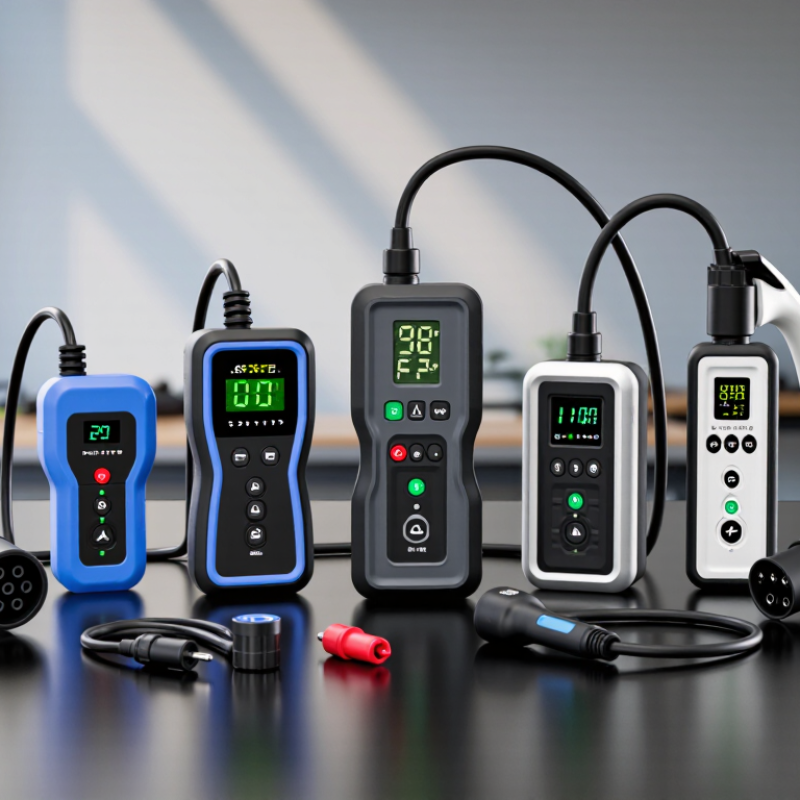
What EV Charger Testers Measure and Who Uses Them
An EV charger tester checks how a charging point behaves before a vehicle relies on it. Depending on the instrument, it can verify voltage, phase sequence, protective-earth continuity, and residual-current protection. Many models simulate a vehicle connection through control-pilot and proximity-pilot signals. This lets a technician check whether the charger changes states as expected. Some testers also support load measurements or insulation checks, but capabilities vary.
Small details matter. A loose test lead or incorrect adapter can distort a reading, so setup deserves care. Installers use testers during commissioning and after repairs. Service technicians use them to investigate faults, such as a charger that starts but stops when the cable locks. Inspectors and training staff may use them to document test results or demonstrate safe procedures. The exact checks depend on the equipment and the site.
A tester does not measure a car battery’s health, and one passing result cannot guarantee long-term charger reliability. Readings are snapshots. Record the test conditions, instrument settings, and any unusual behavior, rather than relying on a single number. I would also avoid treating every result as self-explanatory; confusing displays and rushed checks can leave useful clues unnoticed.
How Global Charging Standards Affect Tester Compatibility
Global buyers should treat charging standards as a compatibility map, not a checklist of plug shapes. IEC 62196 covers connector interfaces, while IEC 61851 addresses charging-system requirements. Regional systems, including Type 1, Type 2, CCS, and GB/T, can differ in pin layout and communication signals. A tester that only checks continuity may miss a failed control-pilot response or an incorrect proximity signal.
The plug may fit. The test may still fail.
The International Energy Agency’s Global EV Outlook 2024 reports more than four million public charging points worldwide in 2023, around 40% more than in 2022. That expanding network increases the need for testers suited to local AC and DC equipment. Buyers should check supported connector adapters, voltage and current ranges, protocol simulation, and safety-test functions. A tester designed for one regional standard may need extra modules for another. This detail is easy to overlook, especially when product specifications list connectors but not supported test sequences.
Tips: Before purchase, match the tester’s documented standards to the chargers you will inspect. Ask for test procedures and calibration records, then verify performance with a known reference unit. Keep adapters clearly labeled in the field. Small mismatches can waste a full site visit.
Which Safety, Accuracy, and Usability Features Matter Most
A useful EV charger tester must verify safe operation, not merely show that power is present. Check that it can assess protective-earth continuity, control-pilot states, and fault responses, with procedures aligned to applicable IEC 61851 requirements. Clear warnings matter when testing outdoors, where wet gloves and poor lighting can make small controls difficult to read. Small details matter. Look for a rugged case, securely rated leads, readable results, and simple menus. I still find menu complexity easy to underestimate.
Accuracy depends on more than a large display. Buyers should check measurement range, stated uncertainty, and calibration traceability, then confirm the tester supports local connector types and supply conditions. The International Energy Agency’s Global EV Outlook 2024 reports that public charging points exceeded four million worldwide after growing by more than 40% in 2023. More equipment in service makes repeatable checks increasingly useful. J.D. Power’s 2024 U.S. public-charging study also reported that roughly one in five charging visits ended without a charge. A tester cannot prevent every failure, but it can help technicians isolate faults faster. Prefer clear pass/fail guidance, data logging, and instructions that explain limits—not just results. A low price can look attractive; missing safety functions may cost more later.
How to read this: These editorial weights show how the criteria could be prioritized when comparing EV charger testers for global use; they are not test results for specific products. Check applicable local standards, connector types, and electrical ratings before choosing a tester.
Seven EV Charger Testers Compared for Different Buyer Needs
Choosing an EV charger tester depends on the fault you need to find. The IEA’s Global EV Outlook 2024 reports nearly 14 million electric car sales in 2023, about 18% of global car sales. That growth makes dependable commissioning and maintenance tools increasingly important. For quick field checks, a compact socket tester is easy to carry. An EVSE simulator checks whether a charging point responds correctly to a vehicle connection. Small, but useful. Installation testers add checks for protective conductors and residual-current protection, while insulation testers help investigate suspected cable faults.
The other options suit more specialised work. A portable load tester checks charger behaviour under demand; a protocol analyzer examines communication between vehicle and charger; and a reference instrument supports accuracy checks in a workshop. These are not interchangeable. Global buyers should compare connector compatibility, supported charging modes, measurement range, calibration documentation, and reporting features. IEC 61851 and IEC 62196 are useful standards to check against, but a standards reference alone does not prove that a tester suits every region or task. I would still verify the exact model’s test procedure before purchase. The small print matters. A low-cost tester may cover routine checks but miss diagnostic detail; a feature-rich unit may be excessive for a mobile technician. Some comparison criteria are easy to overlook, especially calibration intervals.
How to Choose and Use a Tester in Your Region
Choosing an EV charger tester starts with the connector and electrical system used in your region. Check that the tester supports the local plug type, voltage, frequency, and phase arrangement. It should also match the charging mode and test functions you need, such as protective-earth continuity, residual-current protection, and control-pilot signaling.
The IEA’s Global EV Outlook 2024 reported more than four million public charging points worldwide in 2023, a rise of over 40% from the previous year. More chargers mean more variation in field conditions.
Read the tester’s operating range and instructions before connecting it. Confirm that its functions suit the charger, and check calibration records if measurements will inform maintenance decisions. A display reading alone cannot prove an installation is safe. Keep the test area dry, inspect leads for damage, and stop if the equipment or wiring looks unusual. I still double-check connector compatibility; product descriptions can be less clear than expected.
Tips: Match the tester to your region’s connector and supply, then verify its rating before use. Record the charger ID, test conditions, and results. Never open energized equipment; use a qualified technician when a test requires access to wiring.