
ROCKin'teriors
Eco-Friendly stone fabrication and installation
Natural beauty for your favorite space
What Are the Best Eco Building Products for 2026?
Choosing the best Eco Building Products for 2026 requires more than comparing labels or recycled content. Materials must perform well, reduce environmental harm, and remain safe throughout their service life. This introduction examines insulation, structural panels, flooring, roofing, windows, finishes, and water-saving systems through those practical measures.
Real projects reveal details that product brochures often miss. A low-carbon insulation board may reduce heating demand, yet installation gaps can weaken its performance. A recycled flooring product may look attractive, but moisture resistance and indoor emissions still matter. Reliable evaluation should consider verified environmental product declarations, responsible sourcing, durability data, repair options, and local building requirements. Independent certifications can help, although certification alone does not guarantee the best choice for every project.
The 2026 market may offer smarter materials, improved bio-based products, and more transparent supply chains. However, “green” claims still deserve careful questioning. Some products appear sustainable because one feature receives attention while manufacturing impacts remain unclear. Cost, availability, installer skill, and end-of-life recovery also influence real-world results. That is the difficult part.
This guide compares promising products using evidence, field experience, and whole-life thinking. It highlights where each material works well, where it may disappoint, and what buyers should verify before installation. Readers will find practical questions for contractors, manufacturers, and design teams. No product is perfect. Better decisions come from honest comparisons, measurable performance, and a willingness to reconsider attractive claims.
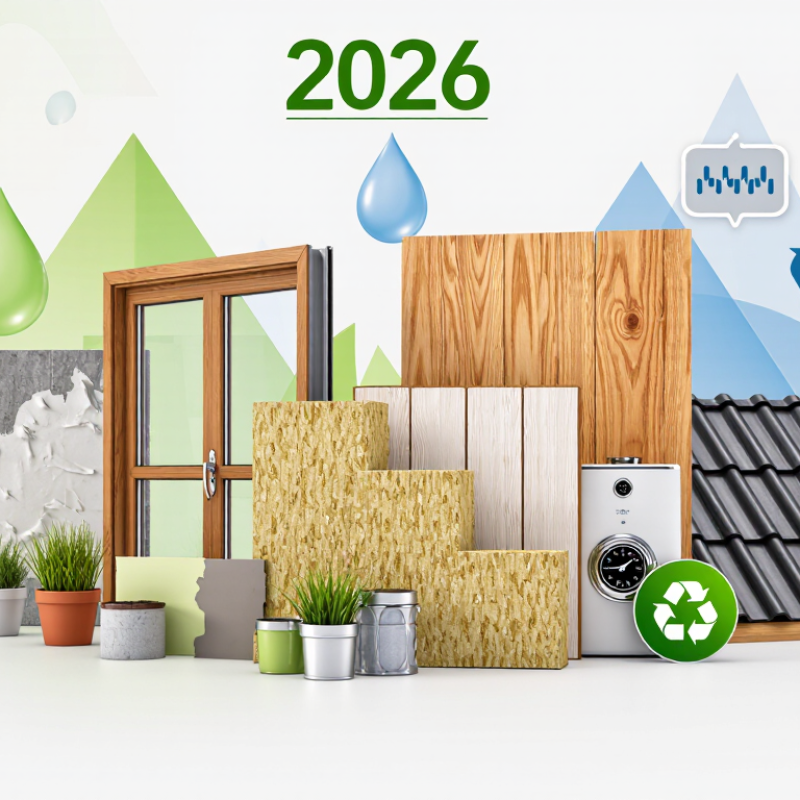
Screen Products by Whole-Life Carbon: Buildings Emit 37% of CO₂ (UNEP)
What Are the Best Eco Building Products for 2026?
Screen Products by Whole-Life Carbon: Buildings Emit 37% of CO₂ (UNEP)
Choosing an eco building product starts with its full carbon story, not its green label. UNEP reports that buildings produce about 37% of global energy-related and process-related CO₂ emissions. That figure makes material selection a serious design decision. A product with low operating energy may still carry heavy emissions from mining, manufacturing, transport, and replacement.
Ask suppliers for verified Environmental Product Declarations, or EPDs. Compare carbon per functional unit, such as one square metre of wall lasting sixty years. Review raw material extraction, factory energy, shipping distance, maintenance, and end-of-life recovery. Reclaimed timber can reduce demand for new resources, but moisture history and structural testing matter. Low-carbon concrete mixes may lower emissions, yet curing conditions and local availability can change the result. Insulation also deserves scrutiny. Its performance depends on thickness, durability, fire safety, and installation quality.
On real project reviews, I have found that the cheapest carbon option is rarely obvious. A locally manufactured product may still use carbon-intensive electricity. A durable material may require more initial carbon but fewer replacements. The data can be incomplete.
That uncertainty matters. Treat estimates as decisions under review, not permanent facts. Specify measurable targets, request updated documentation, and check site waste against the design assumptions. Better products are not simply natural, recycled, or new. They perform well across their whole life.
What Are the Best Eco Building Products for 2026? – Screen Products by Whole-Life Carbon: Buildings Emit 37% of CO₂ (UNEP)
The most suitable product depends on the building function, service life, climate, maintenance, transport distance and end-of-life scenario. The figures below are indicative industry ranges for screening only; project-specific Environmental Product Declarations (EPDs) should be used for procurement.
| Building Product | Typical Application | Indicative Manufacturing Carbon (A1–A3) |
Typical Service Life | Whole-Life Carbon Considerations | 2026 Screening Recommendation |
|---|---|---|---|---|---|
| Cellulose insulation | Roof, wall and floor insulation | Approximately −5 to +3 kg CO₂e/m² at 100 mm thickness | 50–100 years when kept dry | Often benefits from recycled paper feedstock and low manufacturing energy. Biogenic carbon results vary according to the accounting method and end-of-life scenario. | Strong candidate where moisture, fire detailing and settlement are properly controlled. |
| Wood-fibre insulation | Breathable wall, roof and renovation systems | Approximately −20 to +8 kg CO₂e/m² at 100 mm thickness | 50–100 years when protected from prolonged moisture | Can store biogenic carbon temporarily. Forestry practices, resin content, transport and disposal assumptions materially affect results. | Prefer where hygrothermal design and responsible timber sourcing are verified. |
| Mineral wool insulation | Fire-resistant wall, roof and service-zone insulation | Approximately 4–12 kg CO₂e/m² at 100 mm thickness | 50– 성? years; commonly designed for the building life | Higher process energy than many bio-based insulations, but strong fire performance and dimensional stability can reduce replacement risk. | Use when fire safety, acoustics and durability outweigh a slightly higher initial footprint. |
| Expanded polystyrene (EPS) | External wall, foundation and floor insulation | Approximately 6–16 kg CO₂e/m² at 100 mm thickness | 50 years or more when protected | Low weight reduces transport impacts, but fossil feedstock, blowing agents, fire detailing and recycling availability must be assessed. | Consider where its performance and availability provide a whole-life advantage over alternatives. |
| Extruded polystyrene (XPS) | Below-grade and high-moisture insulation | Approximately 15–30 kg CO₂e/m² at 100 mm thickness | 50 years or more in suitable conditions | Often has higher manufacturing carbon than EPS. Moisture resistance may prevent premature replacement in demanding assemblies. | Reserve for applications where compressive strength and moisture resistance are essential. |
| Lower-carbon concrete | Foundations, slabs, frames and structural elements | Approximately 120–250 kg CO₂e/m³, depending on strength and cement replacement | 50–100+ years with suitable design and maintenance | Cement content, supplementary cementitious materials, curing, reinforcement, transport and carbonation during use are important variables. | Specify performance-based concrete and minimize unnecessary volume before selecting mix substitutions. |
| Conventional concrete | General structural and civil construction | Approximately 200–400 kg CO₂e/m³ | 50–100+ years with suitable design and maintenance | High volume can dominate upfront carbon. Durability, thermal mass and long service life may improve whole-life results in some climates. | Use only after material efficiency, structural optimization and lower-carbon mix options are evaluated. |
| Engineered timber panels | Walls, floors and roofs in lightweight structures | Approximately −300 to +150 kg CO₂e/m³, depending on biogenic carbon accounting | 50–100+ years when detailed against moisture and fire | Potential carbon storage is temporary and must not be treated as permanent removal. Forestry, adhesives, transport, reuse and end-of-life are decisive. | Prioritize efficient structural design, certified sustainable sourcing and future disassembly. |
| Recycled-content steel | Frames, reinforcement, roofs and façade substructures | Approximately 0.6–1.5 kg CO₂e/kg of steel, depending on production route | 50–100+ years with corrosion protection | Electric-arc-furnace production with scrap can reduce upfront carbon. Design for reuse and high-quality recycling can preserve future value. | Specify recycled content, production route and verified EPD data rather than recycled content alone. |
| Recycled-content aluminium | Windows, façades, roofing and lightweight components | Approximately 1.5–5 kg CO₂e/kg, depending on recycled content and electricity mix | 40–75 years, depending on exposure and component design | Primary aluminium is highly energy-intensive. High recycled content, long service life and closed-loop recovery can substantially improve results. | Use only where durability, thermal performance or lightweighting justifies the material quantity. |
| Gypsum board with recycled content | Interior partitions, ceilings and linings | Approximately 2–8 kg CO₂e/m² for standard board systems | 25–50 years, depending on interior use and maintenance | Recycled gypsum and take-back systems can reduce waste. Replacement frequency may be more important than small manufacturing differences. | Design partitions for repair, adaptation and selective disassembly. |
| Clay or lime-based finishes | Interior plaster, breathable wall finishes and renovation | Approximately 0.5–4 kg CO₂e/m² at typical application thickness | 20–50 years, depending on wear and moisture | Generally avoids high-temperature cement-intensive processing. Local sourcing and low replacement rates are important. | Prefer for low-impact interior finishes when performance requirements allow. |
Reference context: The United Nations Environment Programme and Global Alliance for Buildings and Construction reported that the buildings and construction sector accounted for approximately 37% of global energy- and process-related CO₂ emissions in 2022. Carbon ranges in this table are indicative screening values compiled from typical life-cycle assessment and EPD ranges; they are not tied to any company or brand.
Related Posts
-
2025 Top Green Building Products That Will Revolutionize Sustainability
-
What Are the 2026 Top Sustainable Building Products?
-
Why is Green Building Insulation Essential for Sustainable Construction?
-
Exploring the Future of Sustainable Building Products for Global Procurement Success
-
Exploring Unique Features and Applications of Top Sustainable Building Materials for Modern Homes
-
Challenges Faced by Global Buyers in Sourcing the Best Sustainable Building Products